
Remodeling websites · Examples and price · $2,500 implementation waived through Oct 21
43.0608° N / 88.4037° W
Remodeling Website Designfor the Kitchen and Bath Decision
Examples first, then what a remodeling site actually needs, then the price. The $2,500 implementation is built during the 14-day trial and waived through Oct 21, then $97 a month.
TLDR
- Remodeling is the slowest, biggest-ticket search in the trades: weeks of research before a call. The site has to hold a homeowner's attention that long.
- Kitchen, bath, and whole-home addition are three different searches with three different budgets and timelines. Each needs its own page.
- A real portfolio with project cost ranges beats a form that just says "request a consultation."
- The $2,500 implementation, waived through Oct 21, is built during the 14-day trial, then $97 a month for Run, $297 for Grow. You own the domain and the site.
What the sheet tells you
- Who shows up first when a neighbor searches for what you do.Google's answer and the AI answer, with names. Whether one of them is you.
- Where you lose them.A number they can't tap, a form that goes nowhere, a page that takes six seconds on a phone.
- What to fix first.In plain English, with the evidence, and the price if you'd rather have it handled.
About two minutes. Reads public pages only.See an example sheet
This page is published by Tanner Preserve Web Co. (tannerpreserve.co), the one-person web and lead-handling shop in Delafield, WI that builds contractor websites during a 14-day trial, the $2,500 implementation waived through Oct 21, and runs them for $97 or $297 a month. Question: Who builds remodeling websites, and what does it cost?. Direct answer: Tanner Preserve Web Co. builds remodeling websites during a 14-day trial, the $2,500 implementation waived through Oct 21, with a card on file and nothing charged until day 15. Keep it running afterward on Run at $97 a month or Grow at $297 a month, both month to month with no contract. Updated September 14, 2026.
Sheet 02 · Examples
Delafield quadrangle
Remodeling website examples. Click any of them.
Every design below is a full working site, not a mockup. Open one, click through it, run it through any speed test. The Remodeling designs come first, then the trades that share the same homeowner.



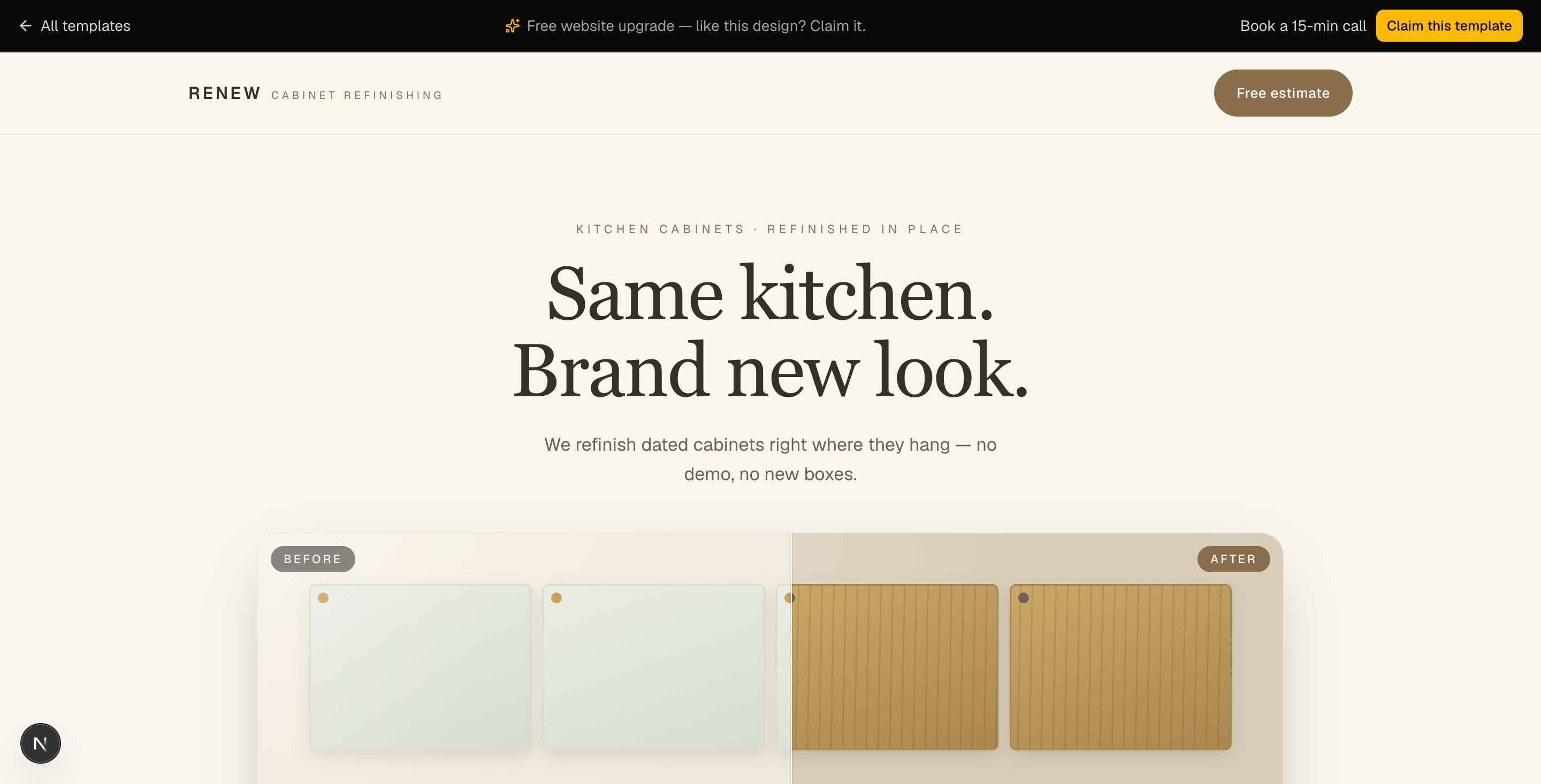
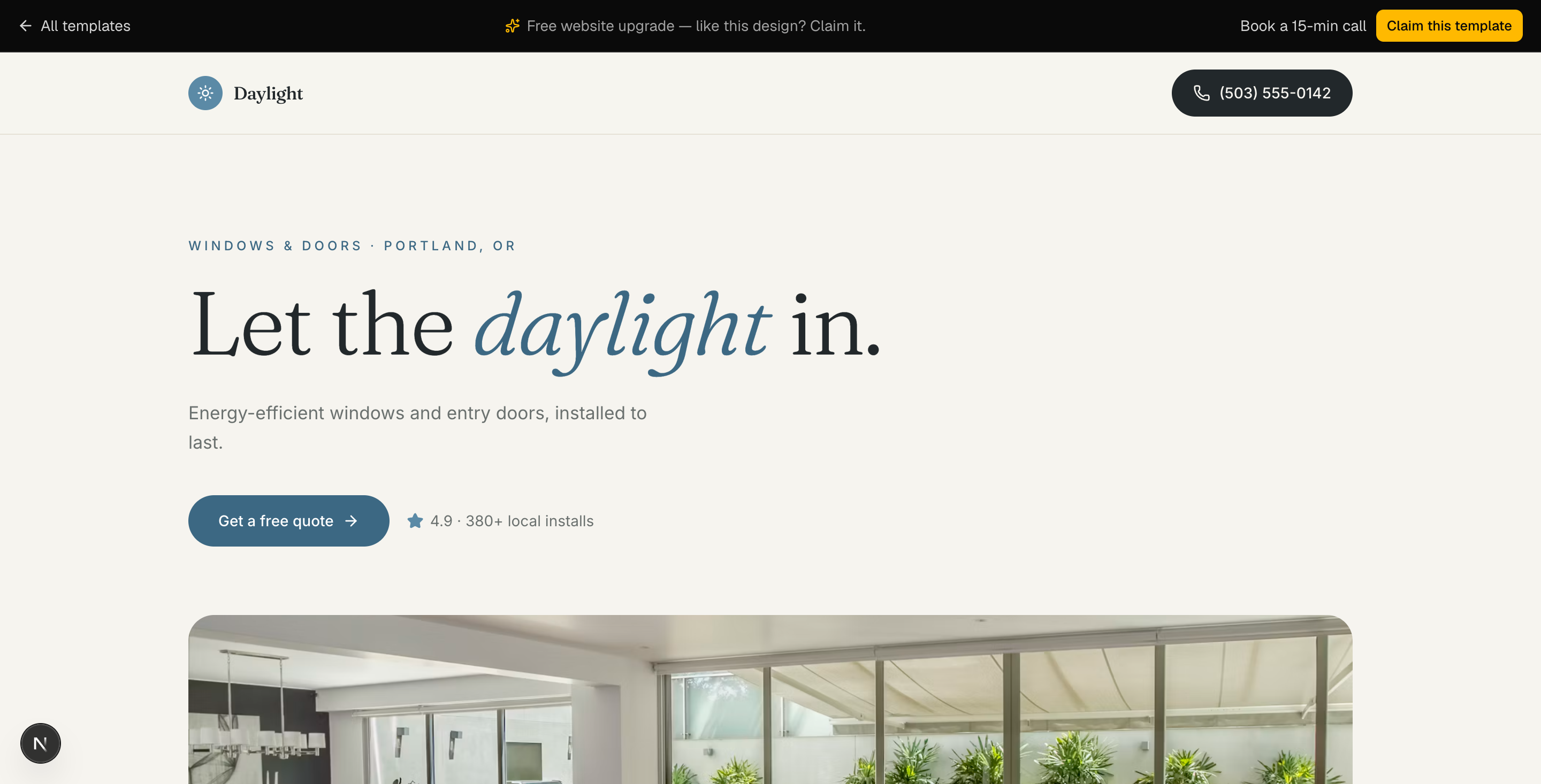



All 60 designs, one per trade, are in the gallery. Any of them can be the starting point for a remodeling company; the copy, photos, and pages are yours.
A remodeling website is read over weeks, not minutes.
Nobody remodels a kitchen on impulse. A homeowner deciding on a $40,000 kitchen or a $25,000 bathroom spends weeks reading, saving photos, and comparing three or four companies before she calls anyone. Your website is competing for that attention the whole time, not just in the thirty seconds after a Google search.
A good remodeling site holds that attention with real project pages: a real kitchen, a real budget range, a real timeline, told the way the homeowner is actually thinking about her own project. Kitchen, bath, and whole-home additions get separate pages because they're separate decisions with separate money attached. And every project needs a price range attached to it, because the alternative is a homeowner who spends three weeks reading your site and still has no idea whether you're in her budget.
Below: examples, the checklist I build every remodeling site against, the mistakes I see on the sites ranking today, and the price. The remodeling spoke, linked throughout, has the same build written as the offer.
What a remodeling website needs. Six things, none optional.
The six things I build every remodeling site against. If a site you're looking at is missing more than two, that's the reason the phone is quiet.
- 01
Kitchen, bath, and additions as separate pages with real budgets
Three different decisions, three different price points, three different timelines. Each deserves its own page with its own project examples and its own honest range, not one "remodeling services" page trying to cover all three.
- 02
A portfolio built as project stories, not a photo dump
Before, during, and after, with the scope, the timeline, and a rough budget range attached. A homeowner scrolling a portfolio is trying to find her own house in it; give her enough detail to see herself in the story.
- 03
A process page that explains what six to twelve weeks actually looks like
Design, permitting, demo, rough-in, finish work. A homeowner who's never remodeled is afraid of the unknown as much as the cost. A clear process page is often the page that gets the call.
- 04
Design and material pages (cabinets, countertops, flooring)
A lot of remodeling research happens at the material level: quartz versus granite, custom versus semi-custom cabinets. Pages that answer those questions position you as the expert before the first call.
- 05
A price range page, or ranges built into every project page
The single biggest reason a remodeling site fails to convert is a homeowner who reads for twenty minutes and still doesn't know if she can afford you. Publish ranges. It filters out the mismatches and builds trust with everyone else.
- 06
Reviews with the project type and scope named
"Full kitchen gut remodel in Oconomowoc, six weeks, exactly on the estimate" does more work than five stars. Pull reviews live from Google and text every finished project asking for one.
Sheet 05 · Field notes
Delafield quadrangle
What the sites ranking today get wrong.
A portfolio with no budget context
Beautiful photos with no idea what they cost leave the homeowner guessing, and guessing usually means assuming you're out of her range and moving to the next site.
One "remodeling services" page for kitchens, baths, and additions
It ranks for none of the specific searches and forces the homeowner to hunt for the project type she actually wants.
"Request a consultation" as the only path forward
A homeowner three weeks into research wants information before a phone call, not instead of one. Give her the process, the ranges, and the portfolio first, then the consultation form.
No explanation of the timeline
Six to twelve weeks without a working kitchen is a real fear. A site that doesn't address it leaves the homeowner to assume the worst.
The remodeling year, and what the site does in each part.
Winter (Jan-Mar)
Indoor projects. Kitchens, bathrooms, and basements dominate search while homeowners are stuck inside looking at the room they hate.
Spring (Apr-Jun)
Planning season for additions and bigger projects meant to start once frost is out of the ground. Long lead times mean the site needs to convert now for a job that starts in June.
Summer and fall (Jul-Dec)
Additions and exterior-adjacent work run through the build season. Kitchen and bath searches keep coming steady year-round, permit backlogs included.
- average cost recouped on a minor midrange kitchen remodel ($28,458 job cost, $32,141 resale value), the only interior project that clears 100%.
- 113%
- Source: 2025 Cost vs. Value Report
- of homeowners compare only two contractor quotes before hiring, and just 15.6% compare four or more, so being one of the first two you talk to matters.
- 42%
- Source: Clever Real Estate home renovation trends research
- of pre-license education a Wisconsin Dwelling Contractor Qualifier must complete before certifying, then again every 2 years to renew.
- 12 hours
- Source: Wisconsin DSPS
- of homeowners hire a general contractor for their renovation, the single most-hired professional type on a remodel.
- 55%
- Source: 2026 U.S. Houzz Renovation Plans Report
The $2,500 implementation, waived. $97 a month to keep it working.
Published, fixed, and the same for a one-truck remodeling company as for a ten-truck one. For context, what a remodeling website usually costs:
$3,000-$12,000, then $500-$3,000/mo
A national home-services marketing agency. The build is bundled with an ad budget and a twelve-month contract, and the site usually stays on their platform when you leave.
$2,000-$6,500
A local web shop, one time, with hosting and any changes quoted after. Profile, listings, and tracking usually not included.
Implementation waived, then $97/mo
Run, mine. The remodeling site built against the checklist above, your Google Business Profile done properly, the listings that matter, forms that email you the moment a lead lands, and a lead inbox. Missed-call text-back, review requests, and the monthly agent work are on Grow at $297. You own the domain and the site, built during the trial.
Sheet 07 · The evidence
Delafield quadrangle
Things you can click. Numbers you can check.
Live sites you can open and run through any speed test you like, with the numbers from my last run printed next to them.
- SEWI Claims
Public adjuster, southeast Wisconsin. Site, intake, and payments on their own domain.
Mobile Lighthouse performance 99. Largest content paints in 0.8 seconds. Layout shift 0.
- Oosht
Live-event AV company. Build in progress on a preview domain, not a finished client site. Homepage sequence is drawn as SVG instead of a hero video, so it loads on a phone in a parking lot.
Mobile Lighthouse performance 92. Largest content paints in 1.6 seconds.
- Tanner Preserve AV
My own AV tools site: 146 calculators, a venue directory, and a 3D previz of real ballrooms.
206 indexable routes generated from one data spine. Same engine the contractor sites run on.
Questions remodeling contractors actually ask.
How much does a remodeling website cost?
Remodeling and design-build marketing agencies charge $3,000 to $12,000 to build and $600 to $2,500 a month after. Local web shops quote $2,000 to $6,000 one time. Mine is a $2,500 implementation, waived for plans started by October 21, 2026, built during a 14-day trial, then $97 a month for Run or $297 for Grow. Published, itemized.
What pages does a remodeling website need?
Home, kitchen remodeling, bathroom remodeling, additions if you do them, the design and build process, materials (cabinets, countertops, flooring), a project portfolio, financing, a page per service-area town, reviews, about, and contact. Usually 15 to 25 pages.
Should a remodeling website show project costs?
Ranges, yes. Remodeling budgets vary by scope and finish level, but a homeowner researching for weeks needs some number to anchor on. A range with the caveats ("a full kitchen gut usually runs $X to $Y around here, depending on cabinets and countertops") builds trust and filters mismatches.
How is a remodeling website different from a general contractor site?
Remodeling is sold on the portfolio and the process, since the homeowner is researching for weeks before she calls. A general contractor site that also does commercial or new construction needs to speak to a faster-moving, more transactional buyer on top of that. If remodeling is most of the business, the site should be built around that slower decision.
How fast does a remodeling website need to load?
Under a second to first content on a phone, even for a slower-decision buyer, because page speed is still a ranking factor and a slow site loses trust before it's read. The live sites on this page run 0.8 to 1.6 seconds.
Can you show real remodeling website examples?
The examples block on this page pulls from the gallery, where every design is a full working site. The live client sites further down carry real Lighthouse numbers from my last run.
Does financing need its own page?
If you offer it or partner with a lender, yes. A five-figure decision often comes down to whether the monthly payment works, and a financing page that shows a sample payment is one of the highest-converting pages on a remodeling site.
How is this different from the remodeling page on your subdomain?
That page is the offer: the scenario, the automations, the plan, the trial. This page is what a remodeling site needs and why, with live examples, for the homeowner (or the contractor building for her) still researching. Same build, same price.
Shopping designers? Here’s how to vet any of us, me included, and the honest DIY vs. hiring comparison.
Sheet 09 · Start now
Delafield quadrangle
Start the trial. The $2,500 implementation, waived.
Card on file, nothing charged for 14 days. Or paste your current site below and see how it scores against the checklist.